
Webb Space Telescope Takes Stunning Captures Of The Ring Nebula!
James Webb Space Telescope (JWST) took an amazing and detailed look at the ring Nebula. Roughly, 2,200 light-years from our earth sits the remains of a dying star. These remnants form a structure known as the Ring Nebula. Scientists have announced a beautiful new view of this cosmic beauty On Monday
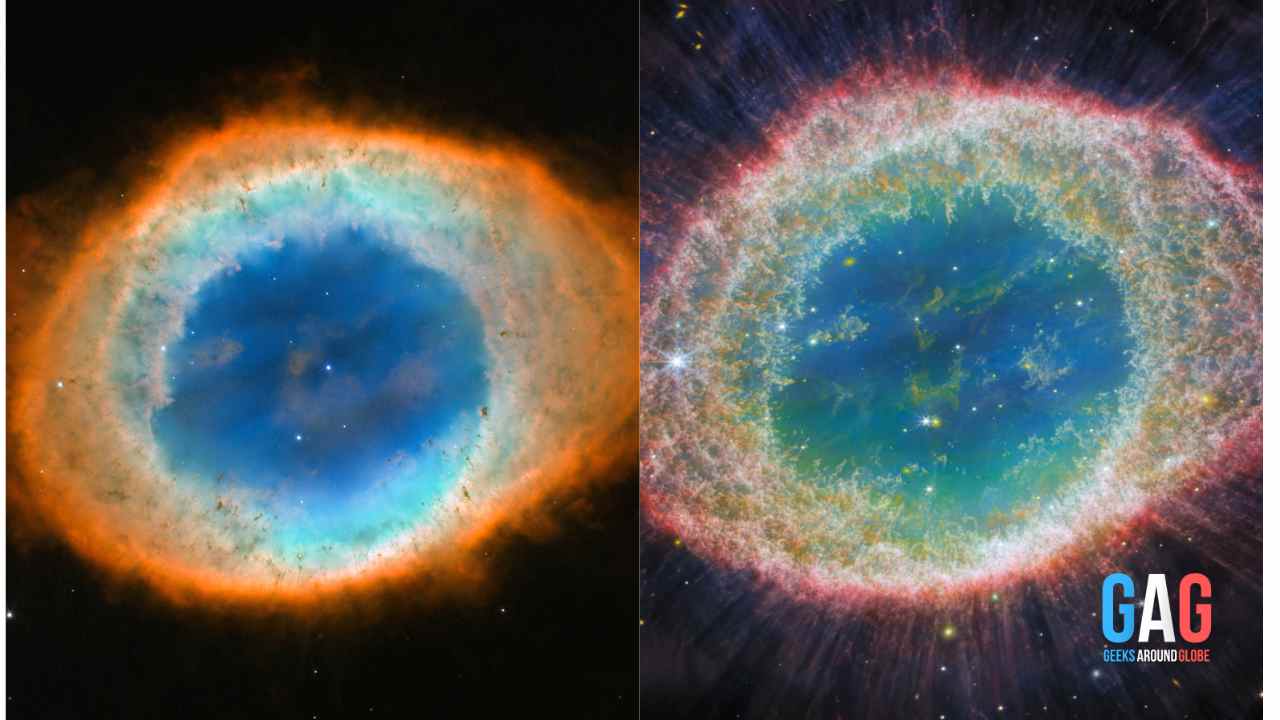
James Webb Space Telescope (JWST) took an amazing and detailed look at the ring Nebula. Roughly, 2,200 light-years from our earth sits the remains of a dying star. These remnants form a structure known as the Ring Nebula. Scientists have announced a beautiful new view of this cosmic beauty On Monday, August 21, 2023. Let’s have a look at what the Webb Space Telescope has taken!
“When we first saw the images, we were stunned by the amount of detail in them,” said Roger Wesson of Cardiff University in a statement. The bright ring has around 20,000 single clumps of rich and dense molecular hydrogen gas. The 3D image shows a structure like a donut, packed with tons of low-density materials within.

Image Source: Hubble Twitter
The remaining of this dying star will soon become a white dwarf. A white Dwarf, as grim as it sounds presents the last stage in a stellar evolution. At its final stages, the star seems to emit some outer shells of gas. According to the JWST, the details taken are from an “unprecedented spatial resolution and spectral sensitivity.”
“The colourful main ring is composed of gas thrown off by a dying star at the center of the nebula,” said the European Space Agency (ESA).

Image Source: Hubble Twitter
Unlike anything seen before, the new images seem to reveal intricate details of the inner structure of the ring. The details are visible with the infrared light wavelengths emitted by the ring. The new image also observes ten concentric “arcs“. Scientists believe that these arcs are from the central sun shedding its outer layers every 280 years. However, this is one of the most remarkable cosmic observations in space!
Ring, ring!@NASAWebb is helping astronomers study the Ring Nebula in unprecedented detail with its infrared observations.
— Hubble (@NASAHubble) August 21, 2023
Hubble's view (left) from 2013 shows the nebula, which is the glowing remains of a Sun-like star, in visible light. Learn more ⬇️ pic.twitter.com/MT0EsnmNqO
Also read,
From obsession to clarity — one original question every week.
We answer one noisy topic at a time, in full. No daily roundup, no thread bait — just the question, the principles, and the system.